Semiconductors
Semiconductors are materials that are inherently strong insulators but have a property which allows their conductivity to be increased by adding other materials.
This capability of a material to allow its conductivity to be controlled offers several useful functions, such managing the direction of the current and varying the resistance based on some external control factors such as light and heat. These functions allow for applications such as switching signals on or off and increasing or decreasing signal strength.
Computing devices work with data represented as binary values (combinations of 0s and 1s). The ability of semiconductors to switch between two states (insulator and conductor) make them very well-suited to building computing devices where the insulator state represents a binary 0 and the conductor state represents a binary 1.
While this is an overly simplified explanation and the science behind the design of computing devices is far more complex, this basic concept is enough to understand the basis of electronics and computing devices.
Before the discovery of semiconductors, vacuum tubes were used to achieve similar functionality. A vacuum tube is a glass tube from which all air has been removed. Heating an element in a vacuum frees up its electrons. There are two elements in the tube: one, known as the cathode, is heated and the other, known as the anode, is connected to a positive voltage. By changing the amount of heat, the number of free electrons changes, making current and its direction controllable.
Semiconductor devices have replaced vacuum tubes due to their significant advantages, including size, cost, reliability, and reduced energy consumption.
Semiconductor materials are used to construct several electronic components which are connected together in various complex combinations to create working computing devices from calculators, to smartphones, to desktops and laptops, and very complex super computers.
Doping
A semiconductor is a material with electrical conductivity between that of a conductor and an insulator. Its conductivity can be modified by adding impurities (“doping”) to its crystal structure.
A molecule is defined as two or more atoms of the same or different elements bound together by sharing electrons. Materials like silicon and germanium have a unique property in their atomic structure. Each has four electrons in its outermost orbital. The four electrons form perfect bonds with four neighbouring atoms, creating a lattice structure.
Metals tend to be good conductors of electricity because they have free electrons, moving solely between atoms. In silicon, all the outer electrons are bound to an electron from another atom, so they cannot move around. As there are very few free electrons moving around silicon, they can be considered an insulator.
Doping
It was discovered that the ability of such materials to conduct electricity can be improved by replacing or adding donor or acceptor atoms to this crystalline structure, thereby producing more free electrons than holes or vice versa. The process of adding donor or acceptor atoms is known as doping. The conductivity of a material can be controlled by controlling the number of impurities added. These materials came to be known as semiconductors as they are neither total insulators nor total conductors.
There are two types of doping:
-
N-type: In this type of doping, atoms with five outer electrons are added to the lattice. While four electrons bind into the lattice, the fifth electron has nothing to bond to, so it is free to move around. By adding excess electrons, silicon can be converted into a conductor. The more the doping, the higher its conductivity. Adding electrons creates a net negative charge, hence the name N-type.
-
P-type: In this type of doping, atoms with three outer electrons are added to the lattice. Its leaves are known as a hole where the fourth electron should have been to complete the bond. It creates a structure where electrons can move into these holes, and the material can conduct electricity. The absence of an electron generates a net positive charge, hence the name P-type.
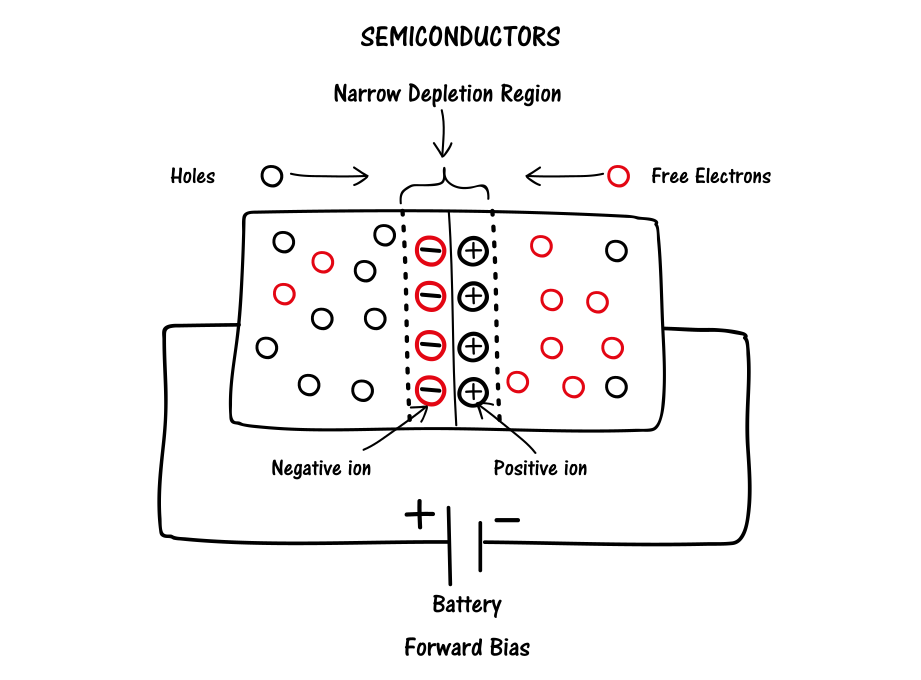
The value of a semiconductor is not derived simply by converting them from insulators to conductors. It is possible to introduce both N-type and P-type regions in the same crystal. Where two differently-doped regions exist in the same crystal creates a semiconductor junction. At these junctions, the behavior of electrons is based on modern electronics.
Semiconductor devices can display a range of useful properties, such as passing current more easily in one direction than the other, showing variable resistance and sensitivity to light or heat. The electrical properties of semiconductor material are easy to modify with just doping or the application of electrical fields or light. It further can be used for amplification, switching, and energy conversion.
Before the discovery of semiconductors, vacuum tubes were used to achieve similar functionality. A vacuum tube is a glass tube that removes all air just to a vacuum. Heating an element in a vacuum frees up its electrons. There are two elements in the tube, where the heated one, known as the cathode, and connected one to a positive voltage is known as the anode. By changing the amount of heat, the flow of electrons will change, making current and its direction controllable. Semiconductor devices have replaced vacuum tubes in most applications due to their numerous and significant advantages, including size, cost, reliability, and reduced energy consumption.
Materials